Frequently Asked Questions
🎯 About JiaDX
JiaDX is a platform for funding rate arbitrage on decentralized exchanges. It helps you capture funding rate differentials between exchanges while eliminating directional price risk through delta-neutral strategies.
JiaDX currently supports:
- Hyperliquid
- Aster
- Paradex
- Lighter
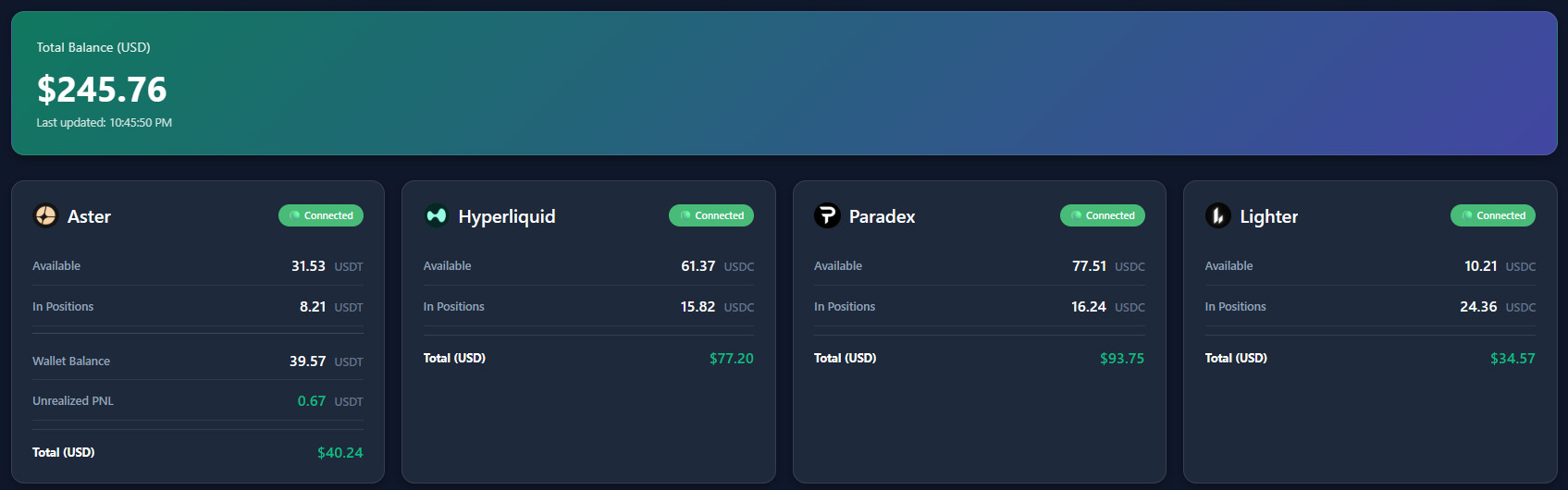
Some features are open to the public, while others are in private beta. Contact us on X (Twitter) for more information.
💰 Funding Rate Arbitrage
Funding rate arbitrage is a strategy that captures the periodic funding payments in perpetual futures markets while hedging price risk. You open opposite positions on two exchanges to remain delta-neutral and profit from the funding rate differential.
No, it's not completely risk-free. Risks include:
- Liquidation risk on one leg
- NET Funding rate can flip negative
- Exchange risk (hacks, bugs)
- Execution slippage
However, it's generally considered lower-risk than directional trading.
Returns vary based on market conditions. Typical APRs range from 5% to 50%+ depending on:
- Market sentiment (bull markets often have higher positive funding)
- Asset volatility
- Exchange rate differentials
- Your leverage and capital efficiency
You need capital on both exchanges to open hedged positions. With 2-5x leverage, a minimum of $500-1000 per exchange is recommended to make the strategy worthwhile after fees.
🔧 Technical Questions
You connect via API keys:
- Generate API keys on each exchange
- Enable trading permissions (not withdrawal)
- Add the keys in JiaDX Settings
Your keys are encrypted and we never have withdrawal access.
We recommend 2-4x leverage for funding rate arbitrage:
- 2x: Very safe, ~50% price move to liquidation
- 3x: Balanced, ~33% price move to liquidation
- 5x: More aggressive, ~20% price move to liquidation
Higher leverage increases capital efficiency but also liquidation risk.
Isolated margin: Each position has separate margin. If liquidated, you only lose that position's margin.
Cross margin: All positions share your account balance. More buffer against liquidation but higher total risk.
We recommend isolated margin for arbitrage to limit risk per position.
If one leg gets liquidated, you're no longer delta-neutral and exposed to price risk on the remaining position. JiaDX has orphan detection that alerts you and can auto-close the remaining leg to limit further risk.
🔔 Alerts & Automation
Yes! Registered users receive email alerts for orphan positions - when one leg of your position closes unexpectedly.
When this happens, JiaDX automatically closes the remaining leg to keep you delta-neutral and prevent directional exposure.
Auto-close automatically closes the remaining leg of your position when one side gets liquidated or closed unexpectedly.
This prevents you from being exposed to directional price risk with an orphan position. When enabled:
- JiaDX detects when one leg is closed
- Automatically closes the other leg on the second exchange
- Sends you an email notification
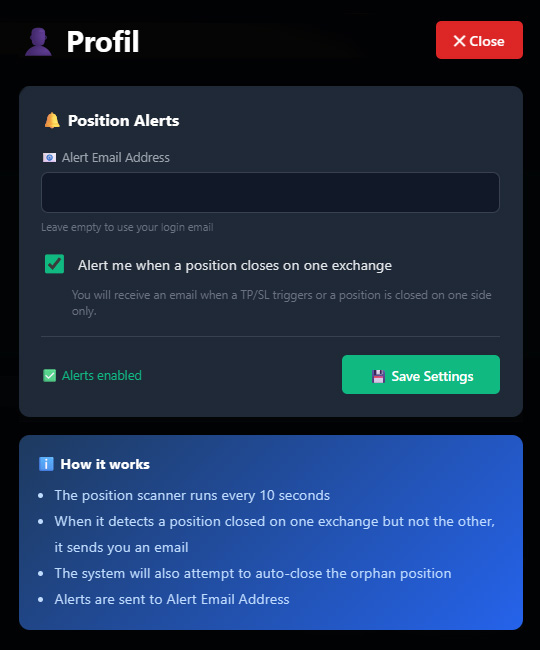
This feature helps limit losses and maintain your delta-neutral strategy.
Email alerts: You need to enable email notifications in your account settings.
Auto-close: This feature is enabled by default for all users.
Even though JiaDX calculates the optimal size for equal notional, several factors can cause small differences:
- Size rounding: Each exchange has minimum size increments (e.g., 1 token, 0.1 token). Your calculated size gets rounded to meet these requirements.
- Price movement: Prices change between when we calculate the size and when the order executes (typically milliseconds to seconds).
- Execution timing: Orders on two exchanges don't execute at exactly the same instant—one might fill slightly before the other.
- Slippage: Market orders may fill at slightly different prices than expected, especially for larger sizes or less liquid assets.
These differences are typically very small (< 1-2%) and don't significantly impact your delta-neutrality. JiaDX shows you the "≈" symbol to indicate these are approximate values.
This is a fundamental concept in delta-neutral trading. Here's why notional-based hedging is correct:
The Problem with Token-Based Hedging:
If you hold 100 tokens LONG on Exchange A and 100 tokens SHORT on Exchange B, you might think you're neutral. But if prices diverge between exchanges (which they always do), your USD exposure becomes unequal:
- Exchange A: 100 tokens × $120 = $12,000 LONG exposure
- Exchange B: 100 tokens × $115 = $11,500 SHORT exposure
You now have a hidden $500 LONG delta. If prices move, your gains and losses won't cancel out.
The Solution: Notional-Based Hedging:
JiaDX matches the USD value (notional) on each exchange, not the token count. This ensures that a 1% price move produces equal and opposite PnL on each leg.
- Exchange A: $500 notional ÷ $1.20 = 416.67 tokens
- Exchange B: $500 notional ÷ $1.25 = 400.00 tokens
Different token counts, but identical economic exposure. This is true delta-neutrality.
Key Takeaway: Delta-neutral means matching USD exposure, not token quantity. That's why you'll see different token amounts on each exchange—it's intentional and correct.
This is intentional and provides a more accurate picture of your real position value.
How Exchanges Calculate Notional:
Most exchanges display notional using the mark price or last traded price:
- Notional = Size × Mark Price
This is a theoretical value that doesn't reflect what you'd actually receive if you closed your position.
How JiaDX Calculates Notional (Size from Bid/Ask):
JiaDX calculates the real exit value by looking at the actual orderbook:
- LONG position → You would sell → Use the bid price
- SHORT position → You would buy back → Use the ask price
Formula: Notional = Size × Exit Price (bid or ask)
Why This Matters:
The bid/ask spread can be significant, especially for less liquid tokens. If you have a LONG position and the mark price is $1.00 but the best bid is $0.98, your real exit value is 2% lower than what the exchange shows.
Example:
- Position: 1000 tokens LONG
- Mark price: $1.00 → Exchange shows $1,000
- Best bid: $0.98 → JiaDX shows $980
JiaDX's value is more accurate because $980 is what you'd actually receive if you closed right now.
Key Takeaway: JiaDX shows the real delta of your position at any moment T, based on what's actually in the orderbook—not a theoretical mark price. This helps you make better rebalancing decisions.
🔐 Security
Yes. Your API keys are:
- Encrypted at rest
- Never logged or exposed
- Only used for trading operations
- Should be created without withdrawal permissions
No. We recommend creating API keys with trading permissions only, without withdrawal permissions. Even if someone accessed your keys, they couldn't withdraw funds.